I must admit, I was sort of out to check off trails I had not yet hiked in Pairie Creek Redwoods. On the list is Ossagon Creek and Hope Creek, which are handily across the street from each other. If there is a little time after, then Carruthers Cove as well. I did not plan to do the two together because what I read about the Coastal Trail in between, which just follows the beach, implied that it wouldn't be possible to do unless the tide was quite low because the beach had washed out significantly. I expect the source of that information knows that there is some seasonality to beaches and didn't just happen to come in summer before, see a grand beach, then come again in winter and see much less. Anyway, I got parked, crossed the road, and got going down, which actually requires a short climb at first.
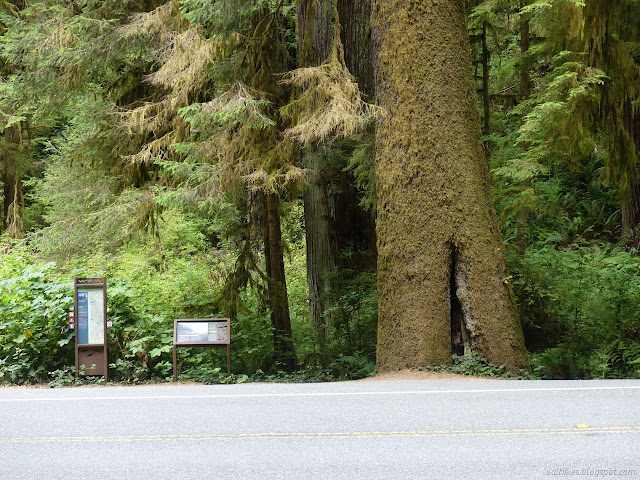
Detailed signs at the trailhead with hike suggestions and trail regulations and a map on one, a little something about the local ecosystem on the other. The trail is excellent, but the trees were getting lost in the low overcast stuff. They're still super massive.
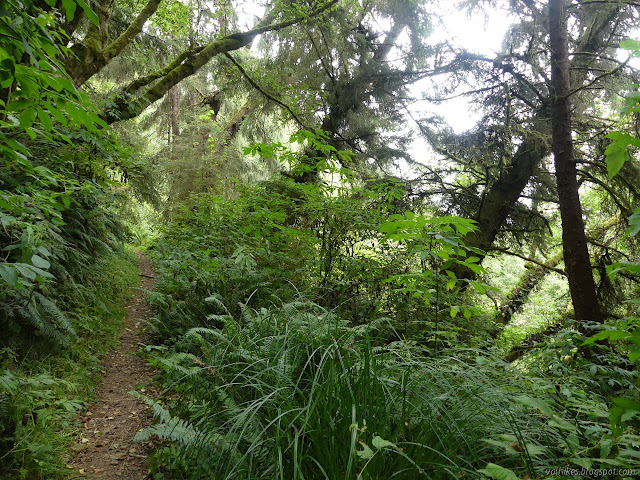
Trees on the far side of the hill were generally smaller. The trail wraps around some redwoods with dark burn a long way up the sides, then down past a varied forest. It took a while to hear much water running and when I did, I barely saw any even when standing in the middle of the bridge over it.
Some merely large trees with long black stripes up the side from some old fire. Looking upstream from the bridge over Ossagon Creek. I see a beach below.
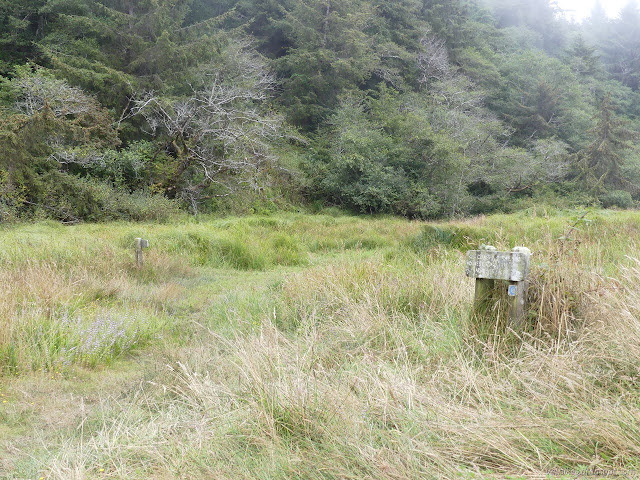
The trail goes pretty quickly. The trails multiply when it hits the flat. It looks like it crosses the creek again, but there's been trees down and more to block it now. I turned right for a trail along the side and found a sign rather randomly by a grassy field. There was no junction, but one would have expected it to be. I came to a puddled crossing and climbed a tree a little to get across with dry feet. Then the trail ran into a well used track through the grass heading both ways along the coast.
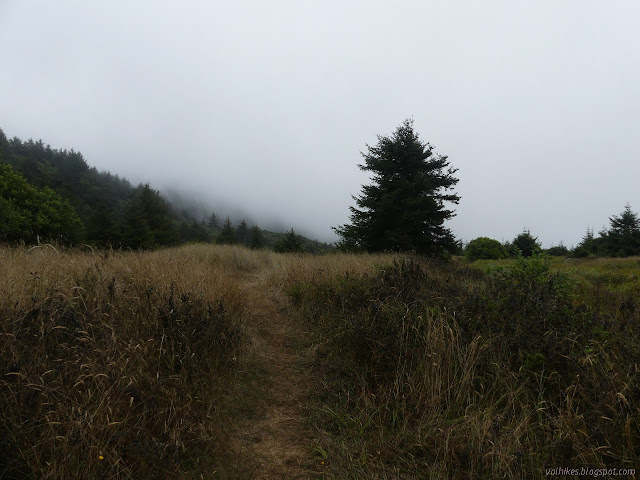
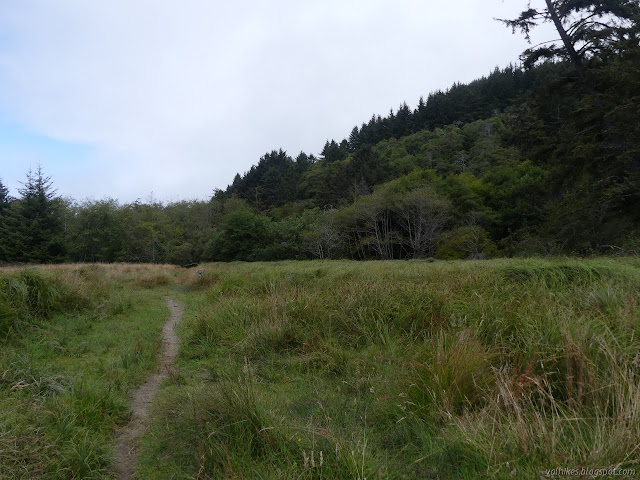
Looking the other way. The coastal hills from the bottom. At the track through the grass and turning south.
I figured I would do the half mile down to the loop I did recently for the rather silly sake of completeness of this section of Coastal Trail. The path split into two well used tracks again and I went right because left seemed to turn back the way I came. I ended up traveling to the beach over a seasonal bridge. I guess that's official trail. At the beach, feet just scatter, generally going north.
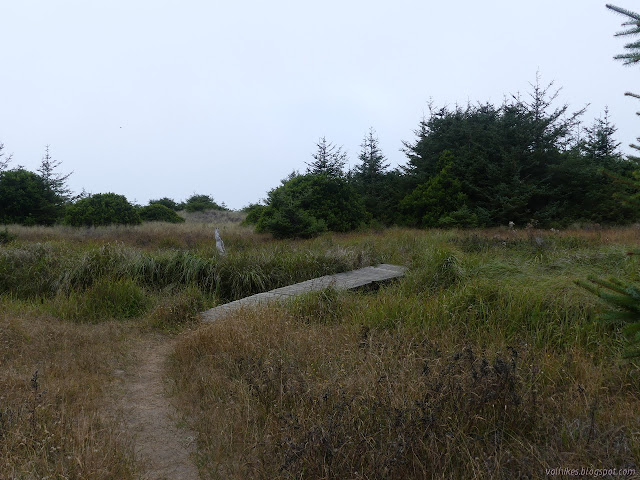
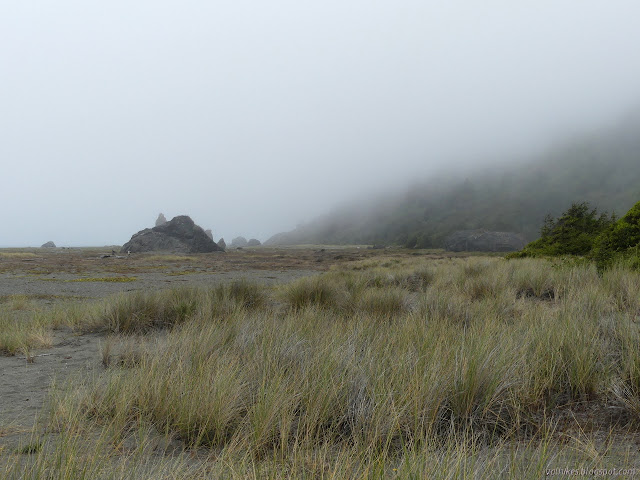
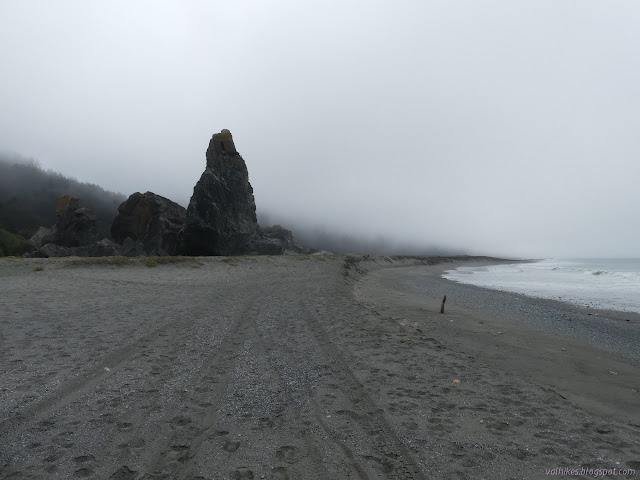
The seasonal bridge over a pool of water tilts a bit. They seem to often tilt a little wonky somewhere along the length, but generally have rope side rails. Ossagon Rocks on the beach. I had heard a family coming down behind me. It looks like they turned right at the big track to get more directly to the rocks. Two of them are toward the left side of the near rock. Blooms on the beach. This appears to be yellow sand verbana.
Since that was Coastal Trail the other direction, I turned back to try the other route. It didn't turn back so much after all, just got back toward the trees on the way past some more signs and probably the former location of the vanquished backcountry campground. According to them, I'd come from the Coastal Trail and another bit of trail I'd missed is Ossagon. It's just a web of trails.
Signs trying to keep things orderly in the grass. They've both got the cute little blue swirls to mark the Coastal Trail.
Things got a lot more orderly as it got up into the trees. The half mile passed quickly except for one small slide area to navigate.
Comfortable little green bit along the Coastal Trail. Arriving at the loop I did a couple weeks ago. This is the shortest and easiest way to get to it without driving miles of dirt road.
Having connected my trails, I turned back to poke around Ossagon Rocks like the family that came down behind me. I followed the signs for Ossagon Trail since I'd missed that bit and conducted another partial tree climbing crossing of the puddled creek before running into the track through the grass once more and taking the right.
A little mule deer with little fuzzy antlers coming in froze so I wouldn't notice it. There could certainly have been a camp here, but there could have been one in a lot of other spaces. Trail just goes gooey as it gets to the area over which creek water flows. Another view of Ossagon Rocks.
I found trail making a direct way northerly and followed it through the sparse vegetation until it suddenly just wasn't. From there, I tried not to stomp too much vegetation while continuing northerly around the rocks.
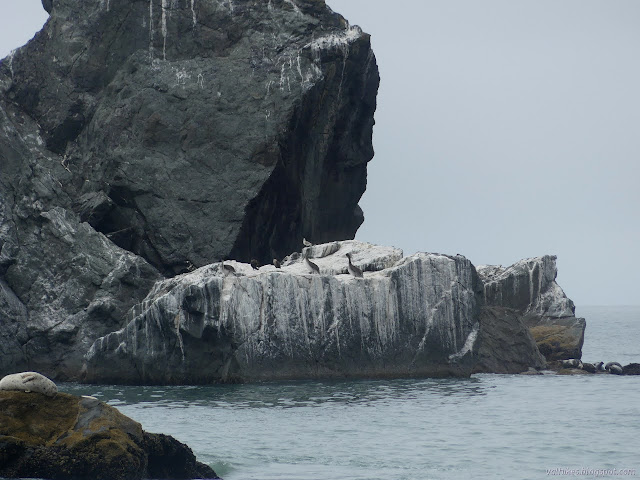
Watching the cormorants through the rocks. The rock tops are encrusted with a dudleya of some sort. Ossagon Rocks from the far side. The tire tracks on the beach aren't from anyone legal.
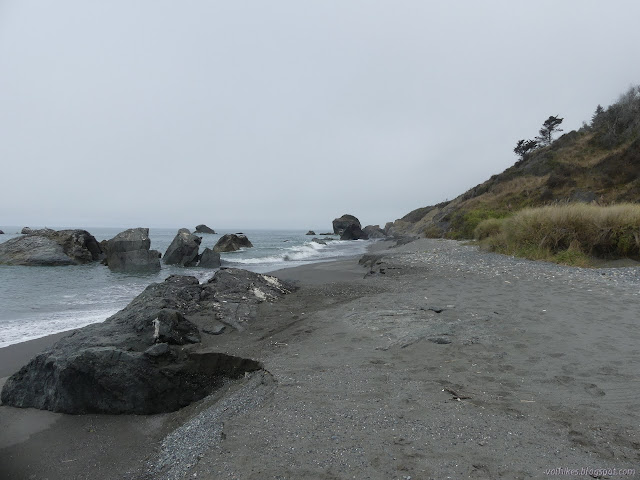
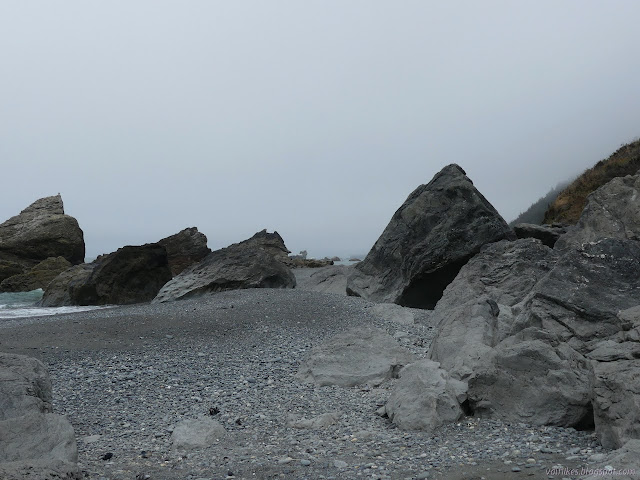
As I continued north, the beach did seem to narrow down to nothing until there is a clump of boulders. At first, they appeared to be getting washed with waves and offer no way around. As I got closer, I could see a way around although a few feet would have to be timed. I didn't actually check the tide charts before leaving since I didn't expect to continue along the beach, but my reading of the beach was that the tide had recently been high and was going out. Also possible was that a larger wave had happened along and the tide was coming in. I'm really not confident in my ability to read the beach that way. I need more time to study it. Anyway, I decided I could risk getting past the rocky spot and at least see what was beyond. If I got desperate, I could follow the other desperate steps that have clambered in the clay like dirt of the bluff.
Looking ahead, it doesn't look promising for getting past. The ocean was particularly flat. A spot where a little water comes down to the ocean. The dark lower layer looks to have a clay consistency.
I had a lot of time to cross beside the one rock and get up on a log wedged between it and another, far above the gentle waves. Then I had to crawl along the well sanded log to get between the rocks. It was easier than it sounds except for my insistence on having a large camera hanging from my neck. On the far side, I just had to walk around a few more big rocks and there was wide beach before me.
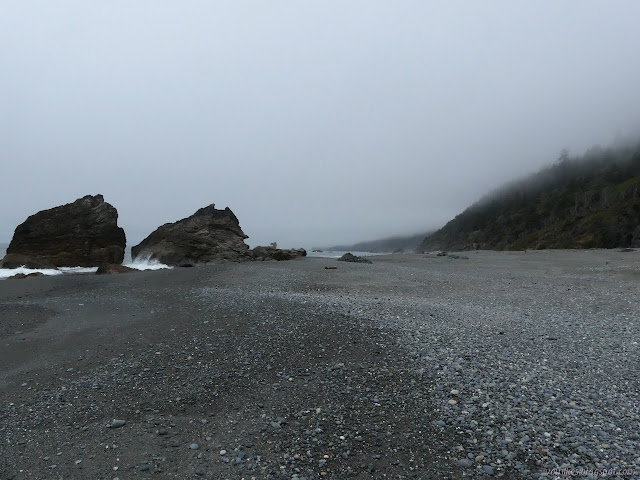
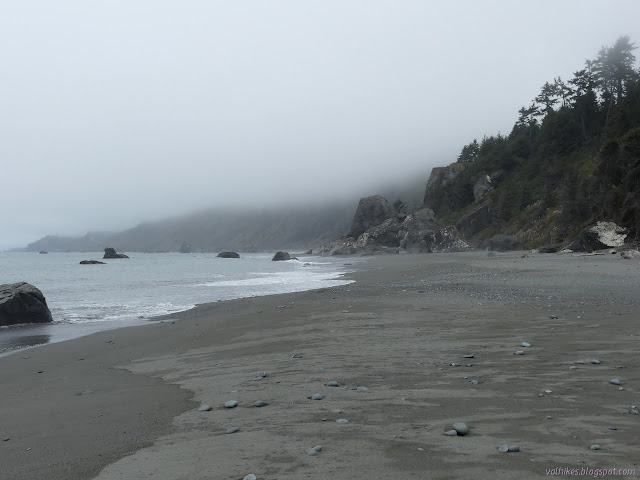
There's plenty of dry beach around these rocks to walk easily. Then there's nothing but beach for a good long while. It's a bit over a mile to the next trail up.
Facing that much beach, what could I do? If the tide was coming in, it certainly wasn't going to come in over all that beach. There were way too many footprints in the sand to all be since the last high tide. I kept going.
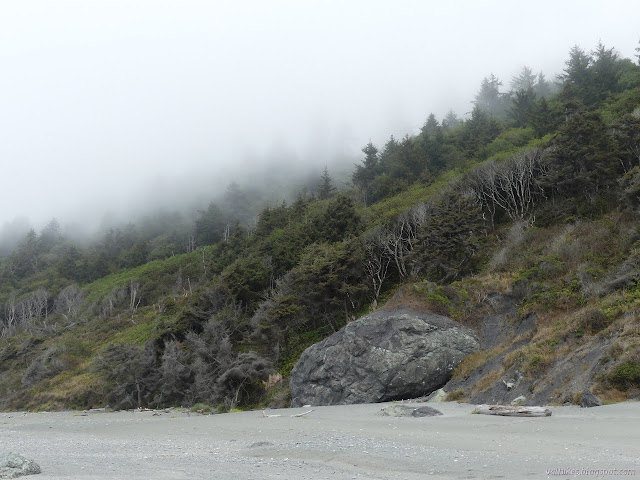
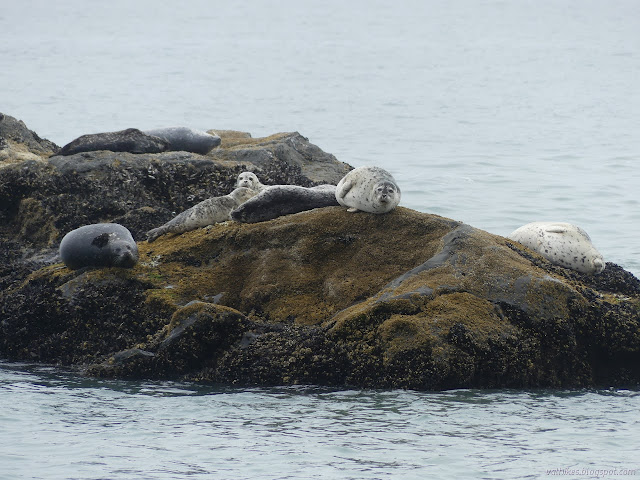
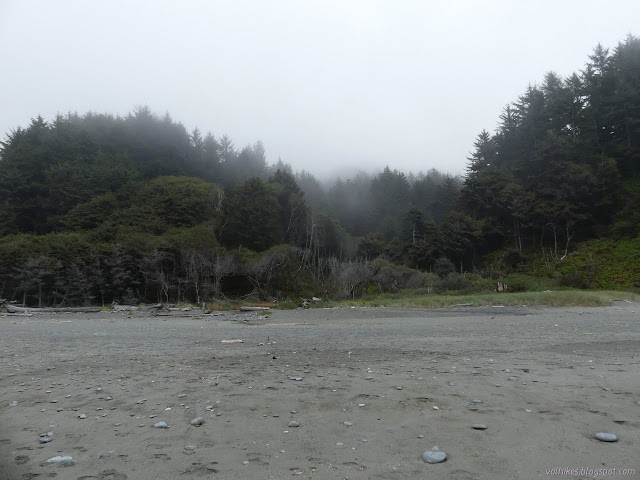
The salt in the air kills off the vegetation that gets too much exposure causing the vegetation on the hill to be sculpted into a gradual increase in height. The high tide line is easily seen as a much more dense area of shells on the beach. There are old footprints above, but not below. Pelicans and sea gulls on the higher rocks and harbor seals on the lower ones. The harbor seals are alert, or at least a few are, as they lounge on their rocks. I also saw a head in the water a couple times.
I found another batch of large rocks that looked washed by the ocean, except I'm fairly certain there are ways past further up the beach. I didn't need them to get past. There were even more footprints on the beach as I neared the trail. I walked to the far end of the beach where driftwood logs had been thrown, noting a likely spot for the climb up. The footprints seemed to fan out from that area, adding confidence to my identification. First, a bit of lunch on the smooth logs.
Another spot of big rocks, but these don't cut off the beach. The only mildly difficult spot was back by Ossagon Rocks. Johnson Creek comes down here and vanishes into the sand. The trail should be just north of the creek. A reddened point rises above the tumbled boulders as a sign post of the finish of the beach section of this part of the Coastal Trail. Pondering the way the footprints gather in the sand. Past here, it becomes impassible, at least at this tide.
After eating, I headed back to the trail heading up. I had not been wrong in the location. It quickly becomes a wide trail on an old road. Carruther's driveway since the area is Carruthers Cove? It's a little direct about getting to the road above.
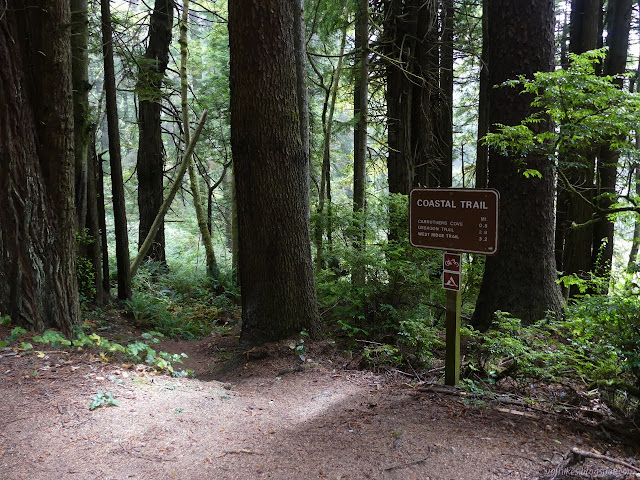
The last view of the beach. It is interesting to see how the salty winds sculpt the trees in the bottom of the creek bed, but not those at the sides. Tall trees of spruce and alder and increasing redwood. One redwood was making it rain from the fog to the western sword ferns below. The sign at the Carruthers Cove Trailhead is a little more basic. It still shows mileage. There is a turnout for parking nearby, too.
The next section of actual trail that is Coastal Trail starts a short way further up the paved road where it ends. I've actually already hiked it, so did not go to see it. Instead I turned to the unfortunate side effect of making it past the rocks, which is the road walk back. I suppose I could walk the trail back, but since I wanted to do more after, I went ahead and went with the road. There was quite a bit more traffic that I expected on the dead end road and it was no worse, just faster, on the parkway.
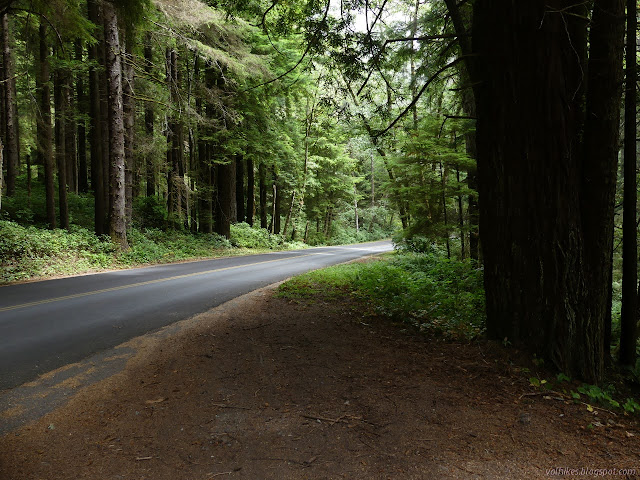
I don't remember this road being wide enough to support a yellow line or very smooth, but that new paving is on top of wider old paving.
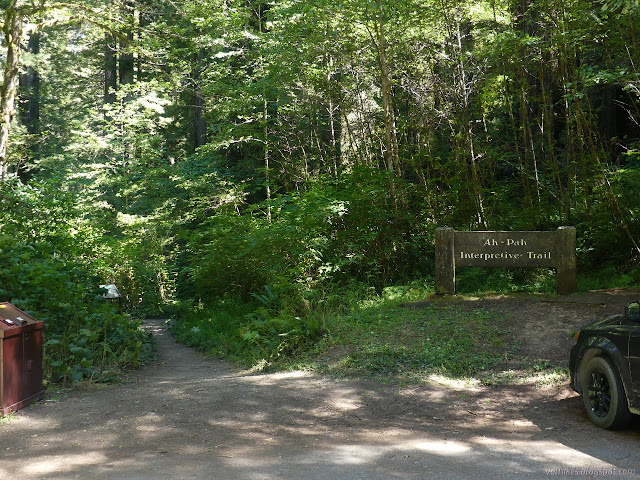
There's supposed to be a trail around memorial groves along the road. I saw the sign for the groves, but no trail nor parking in the area. I wasn't really looking for a trail, either. I stopped at the Ah Pah Interpretive Trail as much to have a break from the road walking as to check its short length off my list of hikes I've not done.
The start of the Ah Pah Interpretive Trail.
The signs along the way are about the removal of an old road, particularly those areas where it partly blocked creeks, in order to restore the ecosystem. This particularly helps out salmon. There was another sign back at a turnout near the Carruthers Cove Trailhead that was about the effect of salt winds on the coastal vegetation which is more my style. I was even admiring its work on the way to that sign. Here, I can try to admire the goneness. There are pictures to help on one sign.
Narrow, but tall trees along the old logging road. Admiring the goneness of the majority of a large, twisting tree.
The trail ends at another memorial grove in audio range of the current highway. Still, the trees are tall and straight and getting ever bigger. I headed back and finished off the road walk. Less than a mile all downhill, it went very quickly. I felt pretty good about getting in more than I'd expected I would.
Liked this? Interesting? Click the three bars at the top left for the menu to read more or subscribe!
Comments
Anonymous said…
Hi how are you? I hope that very good. I'm talking to you on behalf of Suda Outdoors. We would like to share some of your photos on our account (@sudaoutddors) with our community. Clearly tagging you as the photographer in the photo. Stay tuned, thank you very much!
Coconino National Forest Click for map. I seem to be collecting fire lookouts, but the inclusion of Wing Mountain on the list of Arizona lookouts on Peakbagger wasn't what got my notice. It was the simple fact that the quad west of Humphreys Peak is named for Wing Mountain. I'm a bit suspicious about it being a lookout because there is not so much as a trail going up it, much less a road that is common for such things. People who have climbed it seem to have just picked a side and gone for it. I picked the side where there is a shoulder called Little Wing Mountain so I could climb and get the benchmark, then move nearly halfway around the crater to the high point. It is a side that looked highly climbable from afar, which seems like another plus. Forest road 222 (Wing Mountain Road) in seems generally maintained, but 519 only happens to be passable for my little car by a bit of luck. I park at 9230C where someone has had a camp site. It is a little way down the hill fro...
Since I last wrote about digital maps, the S1 Mobile app has been shut down and the Forest Service released a new map app that looks pretty good. It might be time for a new post on maps. (Check the "equipment" tag for older editions.) USFS app in offline mode showing a section of the Pacific Crest Trail north of Marble Mountain Wilderness including intersecting roads, streams, and contours. As before, this will focus on legal, free ways to have maps stored on your handheld computer (AKA "phone") so you can have them anywhere and any time. While these are free, it does help insure that independent developers keep going next year if you send some money toward them. My criteria for a map app: Works offline. If you only have a map when online, you don't have a map. It is as simple as that. This is non-negotiable. Maps should include contours. I'm looking to hike with these maps after all. Shows location. User configurable storage opt...
Redwood National Park Click for interactive map On the prior Thursday, I joined the California Invasive Species Advisory Committee's invasive species tour of Eureka. It was at the last minute because I figured I knew all about these things since I spend a bit of time each week hacking them down as a volunteer. Of course, they were talking about the lesser known things and the tour started out with aphids that affect Sitka spruce terribly as we toured Mouralherwaqh, a patch of land that is Wiyot again. This one is not open to the general public, but we also visited the 'O Rew Redwood Gateway, a piece of land that is Yurok again, and is open to the public as of 1 Aug and where I discovered a new trail. I also noted that although this was most recently an abandoned mill site, there are some nice rounded tree tops poking out of the forest nearby, one of the signs of old growth. I decided I would be back to try that new trail. The sign at the after hours/overflow parking a...
Patapsco Valley State Park interactive map link I was charged with deciding on a hike that kids could do, except I have no experience in this or in evaluating what a particular kid can do. Plus, I would be without any parental supervision. Alltrails offered up Cascade Falls as a possible suitable suggestion, except that it would be done on the weekend and is a very popular location. I liked a climb on Garrett's Pass and a drop on the Cascade Falls Trail, which is 4 miles and only 300 feet or so from bottom to top. (It goes from ~20m to ~100m.) That's not so much, right? And I even had the means for up to 2 kids to be self sufficient, able to carry water, snacks, camera, and a light sweater on their own. Self sufficiency for the win, right? The hike would be in the Patapsco Valley State Park, like most my hikes would likely be. This park has a mix of free lots and pay lots. The pay lots have different prices for in state or out of state, weekends/holidays or weekdays. T...













Comments
Hi how are you? I hope that very good. I'm talking to you on behalf of Suda Outdoors. We would like to share some of your photos on our account (@sudaoutddors) with our community. Clearly tagging you as the photographer in the photo. Stay tuned, thank you very much!